
Honey, I fired the kids
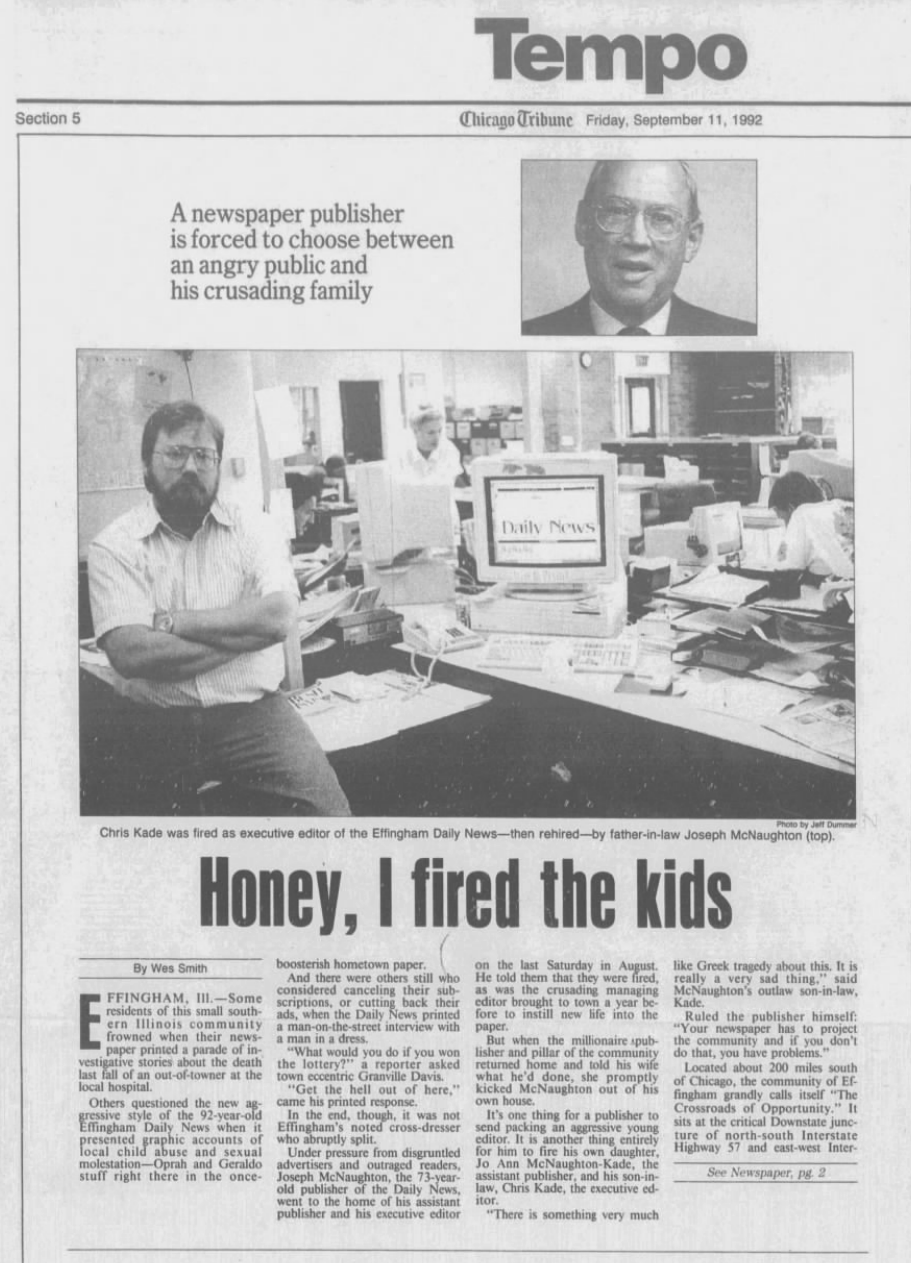
The photo that accompanied the Tribune story had me posed at the editor’s desk, with Jo in the background. Jo’s father, the publisher, was pictured at top.
Looking back from the distance of 34 years, there are definitely things I would have done differently in the crisis that engulfed Jo and me at the Effingham (Ill.) Daily News. I would have been humbler, for one. When I read this article now, as a 68-year-old, I think: pride comes before a fall. This article in the Chicago Tribune was as good a synopsis of the pride and the fall of our brief stewardship of the Daily News as I could have hoped for, both then and in retrospect.
I am also reminded that we did a lot of good and courageous reporting, at least “courageous” in the context of our small-town environment. The series of articles we published about the local hospital won us the Illinois Press Association’s Community Service Award, and led directly to us being fired.
Time heals most wounds. Now, when I tell the story about how my father-in-law fired us and then was himself kicked out of the house by Peggy, my mother-in-law, it usually elicits a good laugh. The humorous aspects of the event were largely hidden during this painful time of our lives, but are undeniable now. Outsiders were alert to it from the beginning, thus the Tribune headline “Honey, I fired the kids.”
Chicago Tribune | September 11, 1992 | By Wes Smith
EFFINGHAM, ILL. — Some residents of this small southern Illinois community frowned when their newspaper printed a parade of investigative stories about the death last fall of an out-of-towner at the local hospital.
Others questioned the new aggressive style of the 92-year-old Effingham Daily News when it presented graphic accounts of local child abuse and sexual molestation — Oprah and Geraldo stuff right there in the once-boosterish hometown paper.
And there were others still who considered canceling their subscriptions, or cutting back their ads, when the Daily News printed a man-on-the-street interview with a man in a dress. “What would you do if you won the lottery?” a reporter asked town eccentric Granville Davis. “Get the hell out of here,” came his printed response.
In the end, though, it was not Effingham’s noted cross-dresser who abruptly split. Under pressure from disgruntled advertisers and outraged readers, Joseph McNaughton, the 73-year-old publisher of the Daily News, went to the home of his assistant publisher and his executive editor on the last Saturday in August. He told them that they were fired, as was the crusading managing editor brought to town a year before to instill new life into the paper.
But when the millionaire publisher and pillar of the community returned home and told his wife what he’d done, she promptly kicked McNaughton out of his own house. It’s one thing for a publisher to send packing an aggressive young editor. It is another thing entirely for him to fire his own daughter, Jo Ann McNaughton-Kade, the assistant publisher, and his son-in-law, Chris Kade, the executive editor.
“There is something very much like Greek tragedy about this. It is really a very sad thing,” said McNaughton’s outlaw son-in-law, Kade. Ruled the publisher himself: “Your newspaper has to project the community and if you don’t do that, you have problems.”
Located about 200 miles south of Chicago, the community of Effingham grandly calls itself “The Crossroads of Opportunity.” It sits at the critical Downstate juncture of north-south Interstate Highway 57 and east-west Interstate Highway 70, and along its freeway frontage boasts a hurly-burly midway of motels, fast-food franchises and truck stops that belie a population of less than 12,000.
Effingham is a proud, business-driven community, and one of its most enduring and successful enterprises is its sole daily newspaper, which the McNaughton family took over in 1949. “We are not a small-town operation,” McNaughton said. Over the years, his family has owned more than 40 small- to mid-sized newspapers around the country. Currently, he controls four newspapers and seven radio stations, including sister stations WRMN-AM and WJKL-FM in northwest suburban Elgin.
More businessman than journalist, McNaughton nonetheless has always taken pride in his Effingham paper. Its present circulation of 13,400 well exceeds the town’s population and enjoys a fairly remarkable market penetration into seven area counties, said McNaughton, who has been known to put papers on porches for free to keep advertisers happy.
“My father felt the old way of earning newspaper income from subscriptions was better, but as we have gotten away from that, it has changed things,” he said. For the vast majority of newspapers, profits are driven by ad sales.
Because his media interests are spread nationwide, McNaughton turned the Daily News’ day-to-day operation over to his strong-willed daughter, 35. Jo Ann did not attend college but apprenticed in nearly every department of the paper, including a three-year hitch in the pressroom. She’s also Effingham’s answer to Mia Farrow, since she’s got two children by her first marriage and eight adopted ones of mixed-race, African-American, Salvadoran, Chilean and European-American descent, ranging in age from 3 months to 18 years.
“Jo Ann loves children, but she works at the paper six hours a day to stay sane,” said Chris Kade. (She does have the help of two nannies.) Decidedly more liberal than her conservative father, Jo Ann was married at age 16, but seven years ago divorced her first husband, who was the general manager of the Daily News, and chose a second spouse out of the newsroom.
Bearded and tending toward bombast, Chris Kade, 34, was never the publisher’s candidate for either son-in-law or newspaper partner. “He and I are polar opposites politically,” Kade conceded. “He’s old school and conservative as a publisher, and I’m young and maybe a bit over-aggressive.”
When the native of Broadview in suburban Chicago married the owner’s daughter, he was a mere cub reporter on the Daily News staff, fresh out of journalism school. He and his wife quickly concluded that the Daily News didn’t work. Readership had dropped, and its half-dozen young reporters and editors were uninspired.
Enter Petr Kotz, 32, a brawny and charismatic graduate of the University of Wisconsin at Milwaukee who had won awards for investigative work at an alternative newspaper in his hometown of St. Paul. A champion of the little guy, he was hired to do a top-to-bottom rejuvenation of the paper as its managing editor.
With a mix already volatile due to the pairing of McNaughton-Kade and Kade, the introduction of the aggressive Kotz last September all but guaranteed a big bang someday at the Daily News, all parties conceded.
The first major reaction from the community to the new chemistry at the paper came in response to a series of probing stories on the circumstances that led to the death last October of Jeff Banks, 29, of nearby Beecher City. Banks, who had been drinking heavily, was taken to the emergency room of Effingham’s St. Anthony Hospital with what appeared to be a minor self-inflicted stab wound but died within 2-½ hours of his arrival.
An Effingham County coroner’s jury ruled that Banks’ death was due to an attempt at suicide and complications that developed at the private hospital. Led by aggressive and sometimes unorthodox reporting by Chris Kade, who occasionally quoted himself in news stories and insisted on giving his own testimony at the coroner’s inquest, the Daily News stampeded with the story to the dismay of civic sentinels who considered the hospital a town treasure.
“It began with the hospital stories, in my opinion. They were doing investigative reporting and sensationalized a lot of their articles while not caring about who it might affect,” said Frank Kabbes, president of the Effingham State Bank and a leading critic of the new Daily News.
Kabbes and more than a dozen other business leaders formed a secret organization called the Community Support Group to coordinate a response. “There was discussion about discontinuing advertising, but we decided that is cutting off your nose to spite your face,” Kabbes said. “There were also some stories around town about a boycott taking place, but it never happened.”
Although Kabbes said McNaughton, his neighbor, was never approached directly, the group’s concerns were made known. Dark rumors of a “Breakfast Club” cabal, as the Community Support Group was known to reporters, incited the young Daily News staff. Reporters and editors received telephone calls at home warning them to watch their words. “They wanted to know why we were tearing the town down instead of building it up,” Kotz said.
In response to such pressure, an unsigned editorial appeared in the paper in early October alleging, “The city’s old boy network is going to great lengths to cover the (Banks) matter up.”
Inspired by their editors, the Daily News staff reported that hospital records showed no surgeon was on duty or on call on the night of Banks’ death even though, as a Level II trauma center, St. Anthony’s was required by state law to have a surgeon available around the clock.
An Effingham County grand jury investigation returned no criminal indictments, but the state Department of Public Health fined the hospital $5,000 for failing to provide a surgeon for Banks.
Letters to the editor poured in. Many chastised the newspaper, but some supported its new activist role. Advertising dipped, but circulation rose. Coverage of the hospital death had scarcely subsided when, in February, the Daily News staff unleashed a series of graphic stories on the death of a 1-month-old child due to possible abuse by a parent.
That story was still brewing this spring when the Daily News went with an even more explicit account detailing a local woman’s recollections of sexual and other physical abuse as a child. Preceded by an editor’s note warning of its “graphic details,” the story rattled even many of the newspaper’s staff. “You are going to go too far periodically when you are testing the limits,” Kotz conceded. “We were relative infants at this type of reporting, but I’d prefer to go too far than do too little.”
Kotz’s yearlong reign stretched the tolerance of a town unaccustomed to displaying its dirty laundry. Racial conflicts. Sexual discrimination. Official misconduct. White-collar extortion. The news Kotz saw fit to print gave fits to many.
By late summer, more angry letters were being sent. Advertisers cut back. Circulation dropped to levels only slightly higher than before Kotz’s arrival. Rumors had the Breakfast Club cabal plotting a coup. The publisher felt heat. “The community was unhappy,” McNaughton said. “In this town, there is just so much investigative reporting you can do before you hit a break point.”
The break-point story that provoked Bloody Saturday at the Daily News was perhaps the least serious of those cited by offended readers and advertisers. It was actually just one more installment in a regular man-on-the-street “Neighbors” interview column. But this Aug. 20 interview featured town eccentric Davis, pictured in uncustomary dress. It brought the Breakfast Club and other critics out of the closet.
“They were operating the paper like college sophomores,” declared hardware store owner and former Mayor Chuck Stevens. “I hadn’t said much until this Granville (Davis) thing came up, then I decided I was going to vote with my feet in terms of cutting my advertising. If people want that Oprah and Geraldo stuff, they can get it at the checkout line in the grocery.”
As many in the community cried foul, Kade responded with an Aug. 24 editorial that minced no words: “With all due respect to all of these people, we say: Baloney … . Granville Davis has as much right to be featured in the newspaper as any other citizen of our area.”
Five days later, McNaughton put the ax to his own daughter, his son-in-law and his hired gun Kotz. “He said the Rotary Club didn’t like what we were doing,” Kotz related. At least two other staff members announced their resignations in sympathy.
In the days that followed, McNaughton reconsidered his move while residing in exile above a relative’s garage. McNaughton-Kade, who owns 25 percent of the Daily News, has been un-fired, told to find a new, less aggressive managing editor, and to stick to “the middle of the road for a while.”
Her husband apparently will be allowed to stay in the fold, as a man without a job title, he says, and not on the printed page. He remains combative. “We intend to lay low, but we are not going to ignore stories,” he said.
Kotz is definitely out. In local television news coverage, he has described Effingham residents as “neanderthals.” In a story that appeared at the top of the Decatur Herald & Review’s front page, he blasted Effingham’s business community as “a moral cesspool” and called the town itself “the most intolerant place I’ve ever lived.”
Kotz, who has four children and a mortgage, later offered regrets about what he’d said in anger, but his venomous parting shots were taken by McNaughton as confirmation that the crusading editor was a poor fit to Effingham’s traditional brand of journalism.
The publisher offered that in a small town such as Effingham, “a rebel can be without a cause much of the time.”